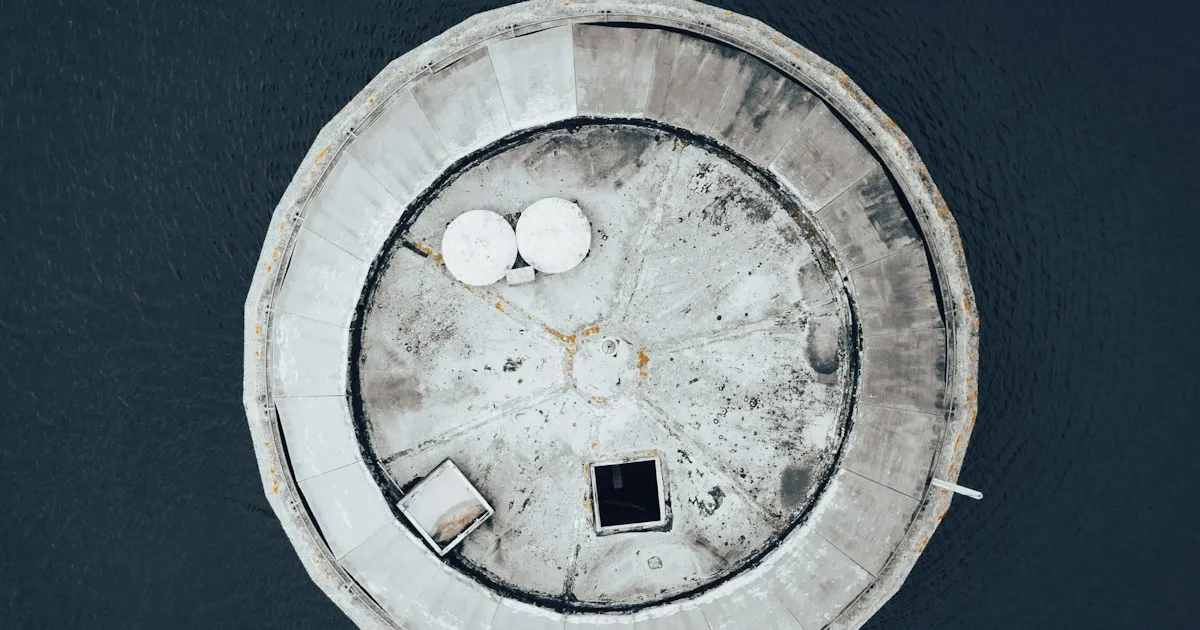
Photo by Ivan Bandura on Unsplash
What happens to water between the source and your tap
I drink tap water without thinking about it, and that’s exactly the intended effect: a technical service that works well is one you forget. Then I read our building’s water bill line by line, out of curiosity, and realised I couldn’t name a single one of the steps I was paying for. Between the river and the glass, far more happens than I had imagined.
A small chemical plant before the glass
Raw water pumped from a river or an aquifer isn’t drinkable. It goes through a series of steps that aren’t mysterious, but that need machines, chemicals and people. First, the large debris is removed by screening and sieving. Then comes coagulation-flocculation: a metal salt is added so that particles too fine to settle on their own clump together. The flocs sink, the water passes through sand and sometimes activated carbon, and it ends up disinfected with chlorine, ozone or ultraviolet light.
Each step targets a different family of problems: suspended solids, micro-organisms, taste, micropollutants. The chlorine you can sometimes smell at the tap isn’t a dosing mistake, it’s insurance. It has to stay active all the way through the network, so that bacteria can’t recolonise a pipe three kilometres from the plant, in a section nobody will open for twenty years.
The price per litre barely pays for the water
This is the part I hadn’t understood. What you’re buying isn’t the water, it’s the fact that it arrives. The resource itself costs almost nothing. What costs money is the kilometres of pipes, the pumps, the reservoirs, the sensors, the on-call crews and, above all, the renewal of a buried network built mostly last century.
That network leaks. In France, a significant share of the water produced never reaches a tap: it seeps into the ground first. The data published by the national observatory puts the average network efficiency at around four-fifths. So we treat water we lose, and we treat it at full price. Repairs are expensive, not repairing costs more later, and the decision gets made on six-year budget cycles.
The service is run by the municipality, but its management is often handed to a private operator under a concession. The price per cubic metre then varies a lot from one town to the next, for the same water drawn from the same aquifer. Nobody compares, because nobody moves house over a water bill.
What treatment doesn’t remove
Standard processes were designed against pathogens and turbidity, not against synthetic molecules measured in nanograms. Pesticide metabolites and some perfluorinated compounds pass through much of the chain, and Anses inspection campaigns regularly find them in distributed water. The technical answer exists: reinforced activated carbon, membranes, reverse osmosis. It’s expensive to build and energy-hungry to run.
And the bill is paid by the customer. This is the mechanism that struck me most: a molecule sold at a profit upstream in the catchment becomes, ten years later, an investment line on a household’s bill, for a household that never spread anything. What an industry didn’t spend to avoid polluting, the public service will spend to clean up, with a delay long enough that nobody makes the connection between the two.
Related articles

Pollination doesn't depend on honeybees alone, far from it
Installing hives doesn't save pollinators. Most of the work is done by wild species almost nobody talks about, and some crops depend on them entirely.
Lire l'article →
Why the years seem to fly by faster as you get older
At ten, summer lasts forever; at forty, September arrives right after July. Here is what neuroscience says about why time speeds up, and what helps.
Lire l'article →Sources
What I read, watched or checked while writing this article.
- World Health Organization. Drinking-water fact sheet: treatment, disinfection and health requirements who.int (opens in a new tab)
- SISPEA, the French national observatory of water and sanitation services. Service prices, network efficiency and management models in France services.eaufrance.fr (opens in a new tab)
- Anses (French food safety agency). Work on micropollutants and pesticide metabolites in drinking water anses.fr (opens in a new tab)