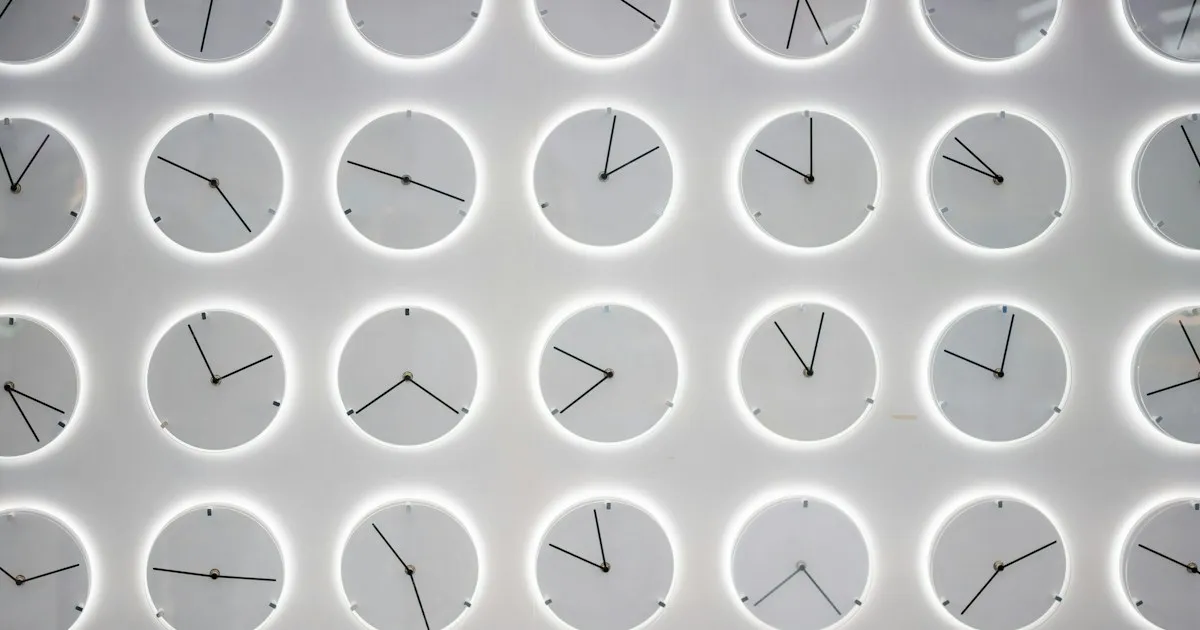
Photo by Donald Wu on Unsplash
Why the years seem to fly by faster as you get older
At ten, summer lasts forever. At forty, September arrives just as you’ve finished July. It’s an almost universal phenomenon: our perception of time speeds up with age. Not our watches, obviously. Our brains.
The proportionality hypothesis
The most elegant theory is called the proportionality hypothesis. It says subjective time is proportional to the time you have already lived. At five, one year represents 20% of your life. That’s enormous, relatively speaking. At fifty, a year is 2% of your life. So your brain “weighs” it differently.
Picture your sense of time as a progress gauge. At five, filling 20% of that gauge takes perceptual time. At fifty, filling 2% goes by in a blink. It isn’t that the years really get shorter. It’s that their proportional weight in your overall existence keeps shrinking.
This hypothesis explains why children find a day endless and adults find a decade surprisingly short.
Memory is time
But there’s a second layer: memory. Your sense of time isn’t linear. It’s autobiographical. A journey you take for the first time lasts a long time in your memory: lots of new details, lots of information to record. The same journey ten years later? You do it on autopilot. Your brain saves energy and records almost nothing. Subjectively, the trip “goes by faster”.
The older you get, the more things become familiar. Your job, your neighbourhood, your routines. From your brain’s point of view, it’s déjà vu. So time doesn’t leave a trace of new memories, it slides by. Meanwhile, a single year at ten is packed with first experiences: first friends, first school, the first time you go on holiday far from home. Every moment builds memory. So every moment lasts.
The brain’s hunger for novelty
That’s why a holiday in an unknown destination “feels longer” than a week in your routine. Your brain has to process. Build memories. Record details. It takes mental time, even though the clock ticks at the same speed.
As you age, to counteract this effect, you would need to seek out more novelty. But you have responsibilities and habits. It’s easier to stay on the rails. So time logically speeds up.
What we can (and can’t) do
The good news: if the theory holds, there’s a small remedy. Seek out the new. Break routines, even small ones. Learn something that seems completely useless. Take a different route to work. Create new memories.
The bad news: it takes energy, psychologically. And it doesn’t reverse anything; it only slows the acceleration.
Further reading:
- Wittmann, M. & Levin, N. (2007). “The subjective expansion of time”, Consciousness and Cognition, 16(1)
- William James (1890). The Principles of Psychology, the chapter on the perception of time
- Mangen, A. et al. (2013). “Neuroscience of novel time perception”, Current Biology
Related articles

Antibiotic resistance: a collective problem, badly shared
Patients are told to finish their course, while most of the problem plays out in farming, drug manufacturing and research that's considered unprofitable.
Lire l'article →
The placebo effect is not just a patient's illusion
Placebo produces measurable effects that are poorly explained and very convenient for anyone selling care. A tour of the mechanism and its twisted uses.
Lire l'article →Sources
What I read, watched or checked while writing this article.