Neutralising a tear gas grenade: methods used in drills
To neutralise a tear gas grenade during a civil protection drill, you approach it with your back to the wind, hands protected, and drown or smother it: a bucket of water, a traffic cone filled with water, soil or soaked cloth. You need at least two people, and a budget of about fifty euros if you start from nothing.
This article covers improvised techniques, the equipment, prices and crew size. It also corrects a few points from the original notes, because in an exam it’s better to justify a move with the right explanation.
CS gas: what you are actually neutralising
CS isn’t a gas. It’s a white, crystalline solid that disperses as smoke when the grenade heats up (INSPQ). Effects appear within 10 to 30 seconds (eyes, throat, coughing) and fade within 15 to 30 minutes once you’re in fresh air (GOV.UK).
Another thing to know: the grenade itself is hot. The same British document warns that canisters can cause burns on contact. Hence the order of priorities: hands, eyes and airways first, the grenade second.
If the drill uses a training grenade (a smoke device without CS, for example), the moves stay the same. Ask the organiser what it contains, because that changes the protective equipment you need.
Equipment to neutralise a tear gas grenade, and its cost
The prices below are rough estimates for a large DIY store. They are not price checks: verify in store before you budget.
| Equipment | What it’s for | Estimated price | Where to find it |
|---|---|---|---|
| Thick leather gloves (welding, heavy gardening) | Holding a hot object | €10 to €25 | DIY store, garden centre |
| Galvanised metal bucket, 10 to 12 L | Drowning the grenade | €8 to €15 | DIY store, hardware shop |
| Traffic cone | Containing the smoke, guiding the water | €10 to €25 | DIY store, road-sign supplier |
| Sealed goggles | Protecting the eyes | €5 to €15 | DIY store, safety equipment |
| FFP3 mask or A1P3 cartridge | Filtering particles | €3 to €8 for an FFP3 | DIY store, pharmacy |
| Bicarbonate of soda (1 kg) | Making the water slightly basic | €3 to €6 | Supermarket, drugstore |
| Potting soil or sand (bag) | Smothering outdoors | €4 to €10 | Garden centre, DIY store |
| Old thick towel or blanket | Extra smothering | €0 (reused) | Your home |
For a full kit with the cone, count between €40 and €70. Without the cone and the soil, you drop below €40. Gloves and goggles are the two items not to skimp on.
A note on the bucket: my original notes mentioned a 5-litre plastic jerrycan cut open. A jerrycan can soften on contact with a very hot object. Metal avoids the problem, and that’s my precautionary choice (I found no source to settle it either way).
How many people for the civil protection drill
Two people at minimum: one operator who handles the grenade, and a partner who stands back, back to the wind, with the water and the bucket ready, and who raises the alarm if something goes wrong. Three is comfortable: the third manages the area and watches the wind. Beyond four, you’re just exposing more people.
If the drill instructions set a crew size, they take precedence over what I write here.
First, the wind and the protection
You approach the grenade with the wind at your back, not facing it. The smoke then drifts downwind and doesn’t reach your face before you make the move.
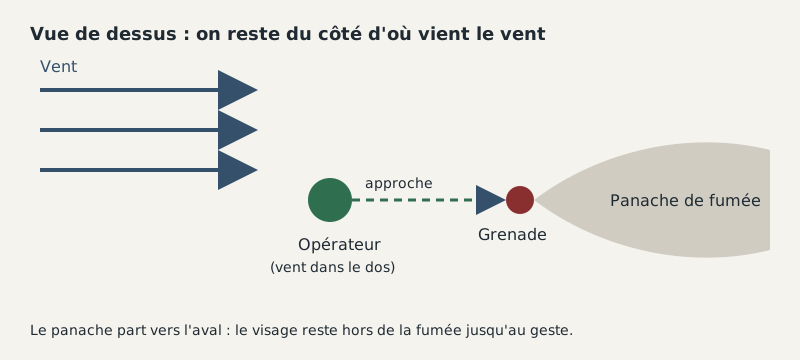
Before you go: thick gloves on both hands, sealed goggles, an FFP3 mask if you can. Firefighter gloves are ideal, thick leather gardening gloves will do, and heavy kitchen gloves are a last resort. Never bare hands. And don’t rub your eyes, even afterwards: since CS is a solid, crystals can stay trapped under the eyelids.
Four neutralising techniques, ranked by likely effectiveness
None of the sources I checked officially ranks these methods. The ranking below comes from field feedback and physical reasoning, and should be checked with the drill organiser. In every case, these moves slow or smother the release, they don’t guarantee it stops at once.
| Technique | Equipment | Advantage | Limit |
|---|---|---|---|
| Bucket of water | Metal bucket, water | Cools and drowns, the most radical | You have to pick up the hot object |
| Traffic cone | Cone, water | No direct contact with the grenade | Plastic cone can melt or lift off |
| Soil or sand | Damp potting soil, terracotta pot | No container needed outdoors | Smoke escapes at the edges |
| Soaked cloth | Towel or blanket, water | Always on hand | Fabric can be pierced or shift |
The bucket: drowning the grenade
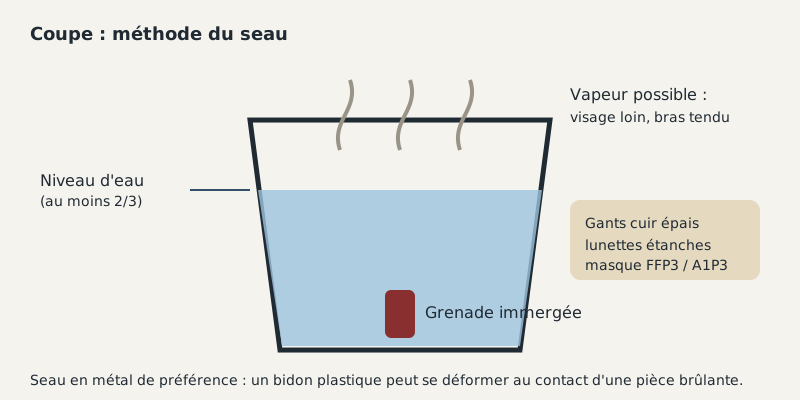
Fill the bucket with water to at least two-thirds. You can add a few handfuls of bicarbonate (see below for why). Pick up the gloved grenade, submerge it completely, arm extended, face turned away: on contact with a hot object, water can throw up steam.
The cone: containing and watering
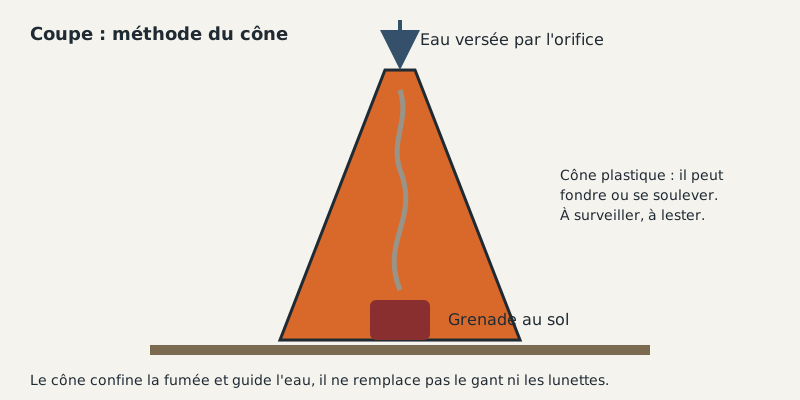
Place the cone over the grenade, without touching it bare-handed. It acts like a chimney: the smoke rises towards the opening at the top. Then pour plenty of water through that opening. If the cone is plastic, keep an eye on it: it can deform, and weighting its base (a bucket of water on the rim, a brick) stops it lifting.
Soil: smothering outdoors
Cover the grenade completely with a large mound of damp potting soil or sand. A large, empty, heavy terracotta flowerpot, turned upside down over it, confines the release. Careful: terracotta can shatter under sudden thermal shock, so don’t pour cold water on it.
Soaked cloth
Without a container or soil, soak a thick towel, a blanket or a heavy garment, and throw it over the grenade. The weight and the water smother part of the cloud. It’s the backup method, not the first one to reach for.
What the original notes got wrong
The notes said bicarbonate “breaks down the acidity of the gas”. That doesn’t hold up: CS isn’t an acid, and it isn’t a gas. The real reason lies elsewhere. CS breaks down (hydrolyses) in water, with a half-life of 15 minutes at 25 °C, and about one minute at pH 9 (INSPQ). Slightly basic water therefore speeds up the breakdown of the CS trapped in it.
Two caveats. CS doesn’t disappear instantly, and the water used stays contaminated: don’t pour it down a drain or near people (GOV.UK).
After neutralising: decontamination and first aid
Move away into open air, facing the wind. Symptoms pass within 15 to 30 minutes. If they last more than 30 minutes, or if you have trouble breathing, call emergency services.
For the eyes, use water or saline for at least 10 minutes. Contaminated clothing goes into a sealed bag and is washed in cold water with ordinary detergent: hot water puts the particles back into suspension (INSPQ). The gloves go in a bag too, and you don’t reuse them for anything else.
Frequently asked questions
Can you pick up the grenade without firefighter gloves?
Yes, with thick leather, heavy gardening or welding gloves, but it’s a compromise. The thinner the glove, the less time you can hold the hot object.
Is water alone enough to stop the grenade?
Not always instantly. Field reports describe grenades that keep smoking for a while after being watered down, although I found no official source explaining it. Step back and wait, and don’t put your hand back in by reflex.
Should you use bicarbonate?
It’s a plus, not a requirement. Water alone does the main job. Bicarbonate speeds up the breakdown of CS in water, nothing more.
What to settle before the drill
Do a dry run with a harmless object of the same size, without smoke: the route, the position of the two crew members, the wind direction, where the bucket goes. On the day, it’s these three or four repeated moves that make the difference, far more than the choice between bucket and cone.
Sources
What I read, watched or checked while writing this article.