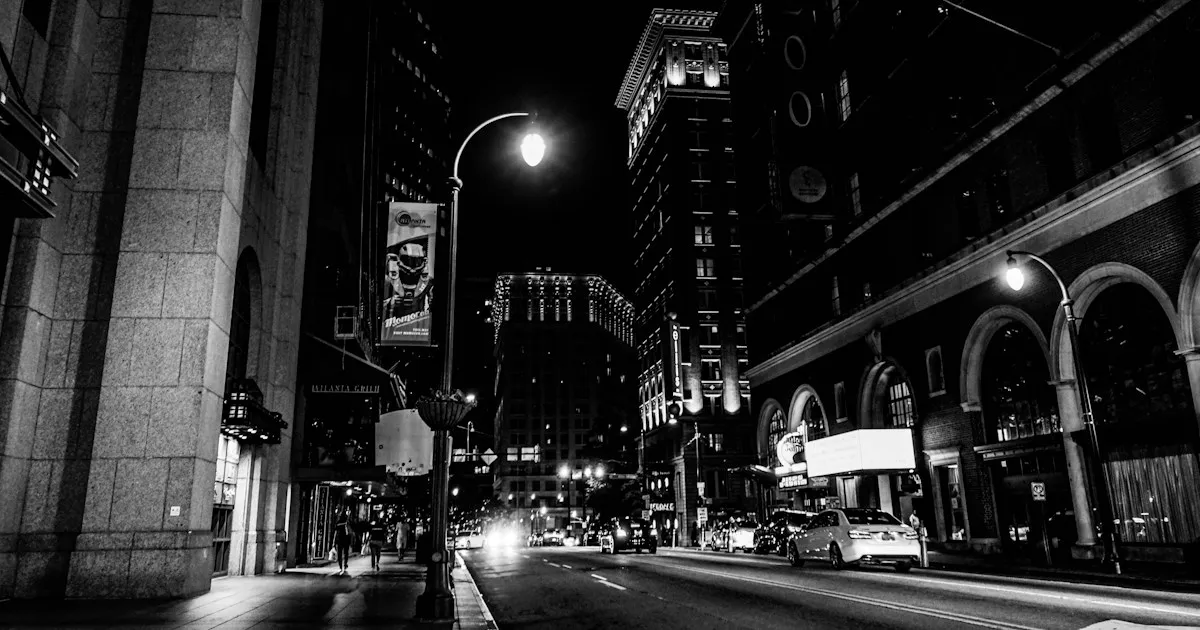
Photo by Tai's Captures on Unsplash
Film noir: money, class and the exit door that keeps closing
I put on a film noir one lazy evening, expecting a police plot. Twenty minutes later, the detective was negotiating his day rate with a rich client, and I realised the murder wasn’t the subject. The subject was a man who works by the hour and a family that owns the city.
Heroes who count their money
The central character of noir is almost always a precarious employee dressed up as an adventurer. A private detective paid per job, an insurance agent, a boxer near the end of his career, a salesman, a former soldier who can’t find his place again. They sleep in rooms rented by the week and drive second-hand cars.
Opposite them stands a house. A real one, with a gate, a servant, a library and an heiress. Noir stages a meeting between these two worlds, and the mechanism is always the same: the poor man enters the rich man’s home for a job, he touches something that isn’t his business, and the rich man is still standing at the end. The bodies mostly end up on the side that had nothing.
A literary origin and a date
The genre comes from the American pulp fiction of the thirties, written by people who had seen the Depression up close and wrote in a short, dry language with no psychology. Then Hollywood took the material during and after the war, with crews partly made up of exiled European filmmakers who brought hard lighting and cut-out shadows.
The visual atmosphere is often read as a simple style. It also has a prosaic reason: low-key lighting costs less than lighting a whole set, and many of these films were B-movies shot fast and for next to nothing. The most imitated look in American cinema is partly a budget constraint that became a signature.
Censorship as co-writer
The production code of the time required that no crime go unpunished and that wrongdoing be punished on screen. It sounds like a moral straitjacket, and it was. But the narrative effect is strange: since the character has to fall, the whole film is built on an inevitable descent, and fate becomes the very material of the genre.
It also produces a hypocrisy you can spot with the naked eye. The petty crook always pays, often with a bullet. The respectable man who set up the job, when he falls, falls neatly, off screen, or not at all. Nobody in these films says that justice isn’t the same depending on your wealth. You just see it happen twice per reel.
Why it still holds up
This cinema is seventy years old, it’s in black and white, the dialogue is written like punches, and it works very well. Perhaps because noir is one of the rare popular American genres where the characters talk about money constantly: how much a room costs, how much a contract pays, how much it would take to leave.
The American dream is present there in negative, in the form of a precise sum that was needed and that they will never have. That’s more honest than most films claiming today to be about work.
Related articles

Hand animation vs the assembly line: what a gesture costs
A shot drawn frame by frame takes weeks. A shot built for the pipeline takes hours. You can see which one was made, and you can't say exactly why.
Lire l'article →
The superhero blockbuster formula, and why it's tiring
Why superhero films look so alike: a calibrated script, a release calendar and assets that must pay off. Forty minutes in, you already know the next scene.
Lire l'article →Sources
What I read, watched or checked while writing this article.
- Wikipedia (fr). Film noir: Hollywood production context, themes and aesthetics of the genre fr.wikipedia.org (opens in a new tab)
- Wikipedia (fr). Hays Code: censorship rules imposed on Hollywood production and their narrative effects fr.wikipedia.org (opens in a new tab)
- Wikipedia (fr). Roman noir: literary origins of the genre and authors of the American Série noire fr.wikipedia.org (opens in a new tab)