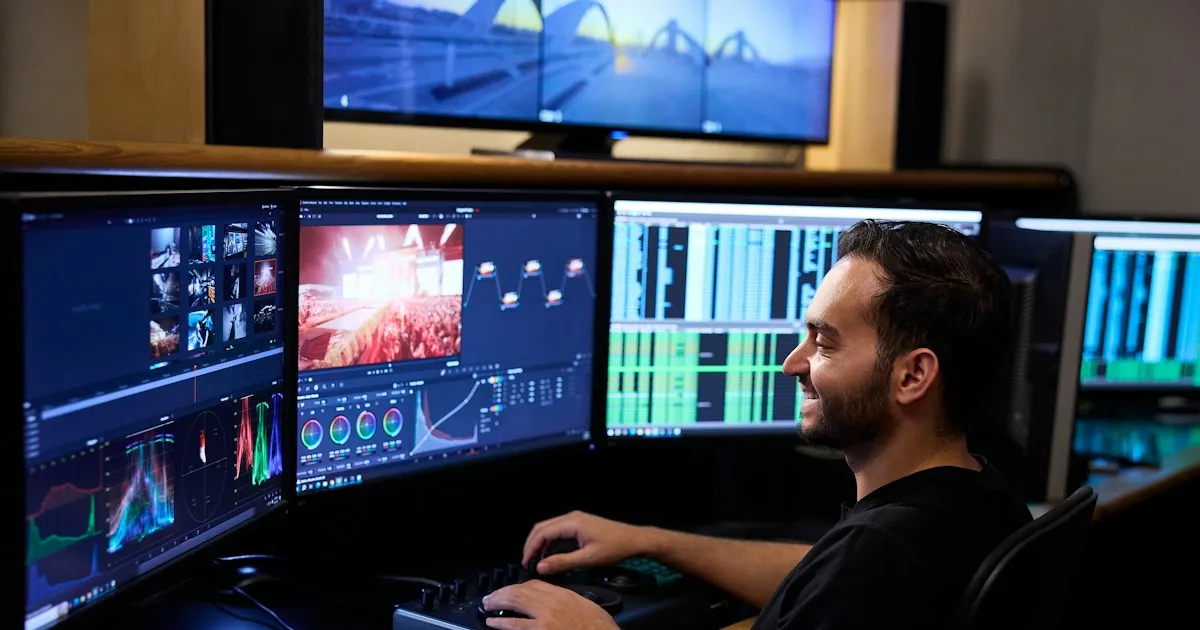
ArtCraft: the open-source Rust suite that mimics Adobe
ArtCraft is a family of free software written in Rust, where each app rebuilds one Adobe application: Photoshop, Premiere Pro, Lightroom, Illustrator, Acrobat, After Effects and InDesign. The first versions date from the first week of October 2026, and the GitHub repositories already have several tens of thousands of stars between them. It isn’t one piece of software under construction. It’s seven projects that share the same method and the same philosophy.
This article takes stock of the whole thing: what each app covers, where it stands, what they have in common, and what remains unclear. Each app will get its own article this week.
Seven apps, seven levels of maturity
The table below summarises the situation as of 9 October 2026. The statuses are the ones the projects announce themselves. None of them has been the subject of a published independent test.
| Adobe | ArtCraft equivalent | Stars (9 Oct.) | Announced status |
|---|---|---|---|
| Photoshop | PhotoCraft | 34.5k | ”early alpha”, not yet a day-to-day replacement |
| Premiere Pro | FilmCraft | about 6.6k | about 50 to 60% ready for real work |
| Lightroom (outside Classic) | LightCraft | 7.5k | 60 to 70% for daily use |
| Illustrator | VectorCraft | 5.0k | 69 to 75% of features, 40 to 55% of the expert feel |
| Acrobat | PdfCraft | 6.2k | about half of Acrobat Pro’s offline features |
| After Effects | EffectCraft | 3.8k | usable, but not for client work |
| InDesign | DesignCraft | 2.1k | no PDF export yet |
A note on naming: the press has called the Acrobat clone PrintCraft, but the repository is called pdfcraft. That’s the name used here.
One architecture for seven apps
What links these projects matters more than how many there are. Each app follows the same blueprint: an engine that handles the data without knowing anything about the interface, a single command registry, and an egui graphical layer on top that can be replaced without touching the engine.
That registry changes everything. A menu item, a shortcut, a slider drag or an agent action all go through the same command, with a stable identifier and typed parameters. The projects say so explicitly: the interface, the command line, the JSON control channel and the MCP server all call the same functions. An agent that can read the registry can therefore do what a user does with the mouse, without going through a screenshot.
The layers are also checked at compile time. Several repositories have a cargo xtask that refuses to let a lower layer depend on a higher one. That’s a design constraint, not a documentation promise.
What this changes for an agent
Each app exposes an MCP server. The setup follows the same pattern: compile the CLI binary, then register it with the client. Tool names vary from one app to the next, and each repository lists them in docs/mcp.md.
Three precautions apply to the whole family:
- Renders are your proof. Each app can render an image or a page to check the result. An agent that edits without checking produces wrong work without knowing it.
- Use undo. The projects all have per-command undo. When a result is bad, the agent should go back, not pile a fix on top.
- Some tools only work in connected mode. Screenshots, clicks and drags require the desktop app to run with its control channel. In headless mode, only data manipulation is available.
What remains unclear
Three points are worth keeping in mind.
Almost all the performance figures come from the projects themselves, without detailed measurement protocols. Several projects publish numbers, but they don’t cover the same operations: video decoding, shape rendering, RAW opening. EffectCraft and DesignCraft publish none. None of the seven publishes a side-by-side comparison with the original.
The method raises a question the projects can’t settle on their own. They’re developed with the help of an AI model, and they say so. The term “clean-room” implies not having copied the competing code. The projects state that they contain no Adobe code and no GPL or LGPL code, but the question of method is being debated outside the repositories, particularly on social networks. This article doesn’t settle it.
Last, stars climb fast. PhotoCraft went from a few thousand to more than 34,000 in a few days. A figure checked today will be out of date in a week.
Licences and trademarks
All seven apps are dual-licensed under MIT or Apache-2.0, at your choice. The trademarks are a different matter: ArtCraft and the names of its apps are reserved. Modified versions must remove them. The projects generally state that they are neither affiliated with nor endorsed by Adobe.
For personal use or a fork, the code licence is enough. To distribute a modified version under the ArtCraft name, read the trademark file first.
The artcraft repository
The main repository, storytold/artcraft, presents itself as “The IDE for artists”. It combines 2D composition, 3D staging and a choice of generative AI models, with an announced catalogue of 62 models. It isn’t one of the Adobe reimplementations. It’s the showcase for the family, and its scope is different: it deals with generative creation, where the seven apps rebuild production tools.
Who it’s for, and what for
Today, the suite is useful in three cases. To learn how production software works without paying a subscription. To automate repetitive tasks through an agent, since the architecture suits that well. To follow a project that’s open from its first weeks, by reading its code and its issues.
It isn’t ready for client work without caution. The gaps are known, and they’re in the details: missing plugins, proprietary formats that aren’t open, slow exports on large files.
The best starting point is simple. Pick the software you use most, open a project you know, and export it. Watch what breaks. That tells you more than any status table.
Related articles
Du code à la vidéo : mon flux de travail
Comment je passe d'un projet de code à une vidéo YouTube, sans perdre la moitié de mon temps dans les outils.
Lire l'article →
Licences open source rachetées : ce que révèlent les forks
Terraform, Redis : quand un projet libre change de licence une fois la communauté captée, et pourquoi les forks repartent presque toujours du même endroit.
Lire l'article →Sources
What I read, watched or checked while writing this article.
- storytold/artcraft GitHub repository: the vision of an IDE for artists, licence, stars and announced catalogue github.com (opens in a new tab)
- storytold organisation page, checked 9 October 2026: list of repositories, stars and last update dates github.com (opens in a new tab)
- AI News Weekly, 7 October 2026: presentation of PhotoCraft, its MCP server and the project's caveats aiweekly.co (opens in a new tab)
- storytold/filmcraft GitHub repository: licence, layered architecture and version 0.4.0 github.com (opens in a new tab)