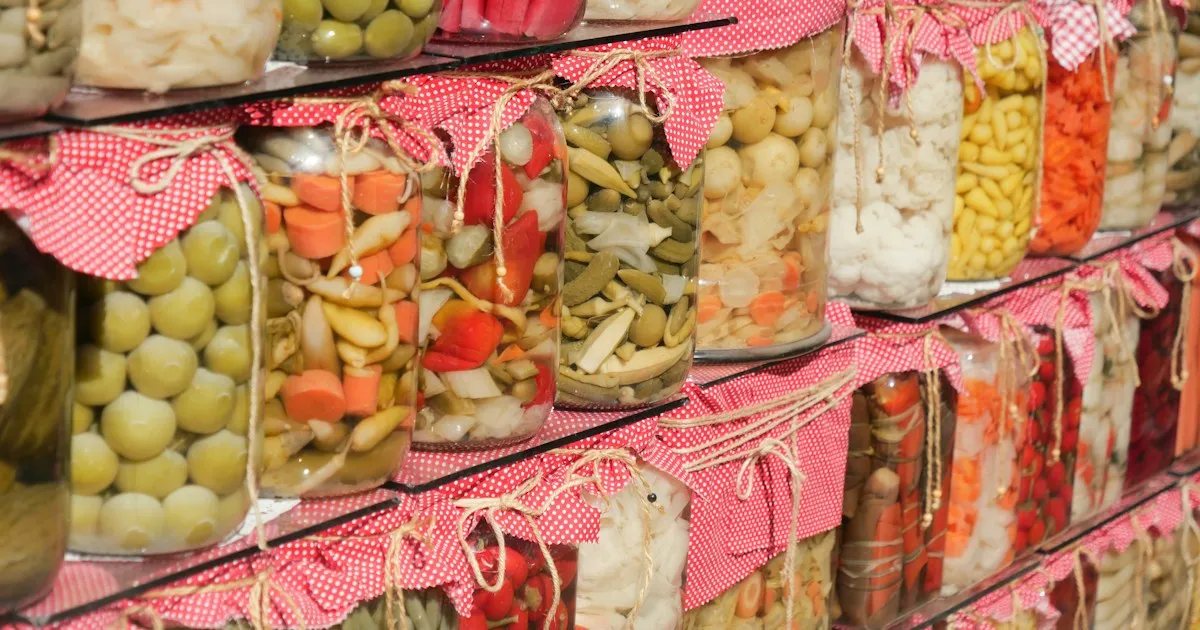
Photo by Towfiqu barbhuiya on Unsplash
Lacto-fermentation at home: preserving food without a fridge
The first jar I ruined smelled of feet. So did the second. With the third I finally understood that I was weighing my salt by eye and my vegetables by guesswork, which is like cooking without scales and hoping chemistry will be forgiving. It isn’t. Since then, I always have three or four jars working at the back of a cupboard, and I no longer buy tinned cabbage.
What happens inside the jar
The principle fits in one sentence: you create an environment where only the bacteria you want can survive. Lactic acid bacteria are already on cabbage leaves. Salt and the absence of oxygen suit them, and not their competitors. They convert the sugars in the vegetables into lactic acid, the acidity drops the pH, and that low pH bolts the door on everything else.
So there’s nothing to add. No starter to buy, no sachet, no special equipment. A jar that seals, unrefined salt, water, and vegetables fully submerged. That last point is the only truly critical one: anything above the brine will mould, anything below ferments.
The method I use
For cabbage, I shred it, weigh it, and salt it at about two percent of the vegetables’ weight, then massage until the cabbage releases enough water to cover itself. For harder vegetables, carrot, radish, cauliflower, I use a separate brine at the same ratio. I pack everything down, add a weight, close the jar, leave it at room temperature for a few days, then move it somewhere cool.
I rely mostly on smell: sharp and acidic means it’s working; putrid means it’s failed, and there’s no grey area.
- a sharp, acidic smell, never putrid
- a cloudy brine, which is normal and expected
- bubbles in the first few days, then a gradual calm
A jar that has gone wrong announces itself without ambiguity. You don’t need a connected sensor, you have a nose.
What it replaces, concretely
A whole fermented cabbage keeps for months without using a single watt. It’s food storage that depends neither on a cold chain nor on a factory nor on a supply disruption. For a similar product bought in a shop, you mostly pay for transport, packaging, pasteurisation and the margins of three intermediaries, and pasteurisation kills on the way the very bacteria you were trying to keep.
Kimchi is the same mechanism with more chilli and an entire culture built around it, including jars buried in the ground to hold the temperature. It isn’t a recent trend of photogenic jars: it’s a preservation technique that fed people long before a compressor took over the job.
The real cost
One kilo of vegetables, fifteen minutes of work, two euros of raw material, and then you wait. Waiting is the one thing I haven’t found a way to speed up, and it’s probably why industry preferred acetic acid and the autoclave.
My fridge is emptier now, and my plates are more interesting. That wasn’t the original plan.
Related articles

Raw-milk cheese: taste versus procedure, and who decides
Native flora, pasteurisation, and why raw-milk cheese keeps disappearing from shelves without ever having been banned. Taste against procedure, explained.
Lire l'article →
Seasonality at the supermarket is a logistics fiction
Strawberries in January, tomatoes in December: the produce aisle no longer follows the seasons, but shipping routes, cold rooms and margins.
Lire l'article →Sources
What I read, watched or checked while writing this article.
- Wikipedia (fr). Lactic fermentation: biochemical mechanism, lactic acid bacteria and acidification of the medium fr.wikipedia.org (opens in a new tab)
- Wikipedia (fr). Kimchi: Korean preparation of lacto-fermented vegetables, ingredients and variations fr.wikipedia.org (opens in a new tab)
- Anses, the French food safety agency: recommendations on preserves and home food safety anses.fr (opens in a new tab)